
Tuscola County Court Records After Arrest
An arrest in Tuscola County can begin with the Tuscola County Sheriff's Office, the Caro Police Department, another municipal agency, or a state officer. If the person is held, booking occurs at Tuscola County Jail. That booking record may list an arrest date, agency, alleged offense, and custody status. The court record is a separate file. It is created when the Tuscola County Prosecuting Attorney reviews the police report and chooses whether to file a complaint or other charging document.
The prosecutor for Tuscola County is Erica Walle. The prosecutor's office is listed at 207 E. Grant Street, Caro, MI 48723, with phone service at 989-672-3900 and weekday hours of 8:00 a.m. to 4:30 p.m. Once a criminal complaint is filed, the case is handled by the correct court. 71B District Court handles misdemeanors and felony probable-cause stages. 54th Circuit Court handles felony criminal matters after bindover or filing in circuit court.
For custody and booking details, the related jail record may matter because it can confirm whether the person was held or released. For the court side, use the case file. Booking photos belong with Tuscola County jail mugshots, while current custody lookup belongs with Tuscola County jail inmate records. A court case search should be used for formal charges, hearings, and dispositions.
Find Tuscola County Court Records
The statewide entry point for public case lookup is MiCOURT Case Search. MiCOURT is not a jail roster. It is the public case-search portal for Michigan courts that participate in the system. A Tuscola County court records after arrest search can use a party name, case number, court filter, and case-type or date filters when available. If the arrest is recent, allow time for the prosecutor and court clerk to process filings before assuming that no court record exists.
The 71B District Court page is the local reference point for misdemeanor cases and early felony proceedings. The 54th Circuit Court page describes felony criminal jurisdiction and directs circuit court record questions to the clerk. The Tuscola County Clerk is listed at 440 N. State Street, Caro, MI 48723, with the main clerk phone at 989-672-3780 and email at clerk@tuscolacounty.org. The circuit court page also lists 989-672-3775 for circuit court records questions.
The MiCOURT Case Search screen is shown here because it is the broadest starting point for Tuscola County court records after arrest.
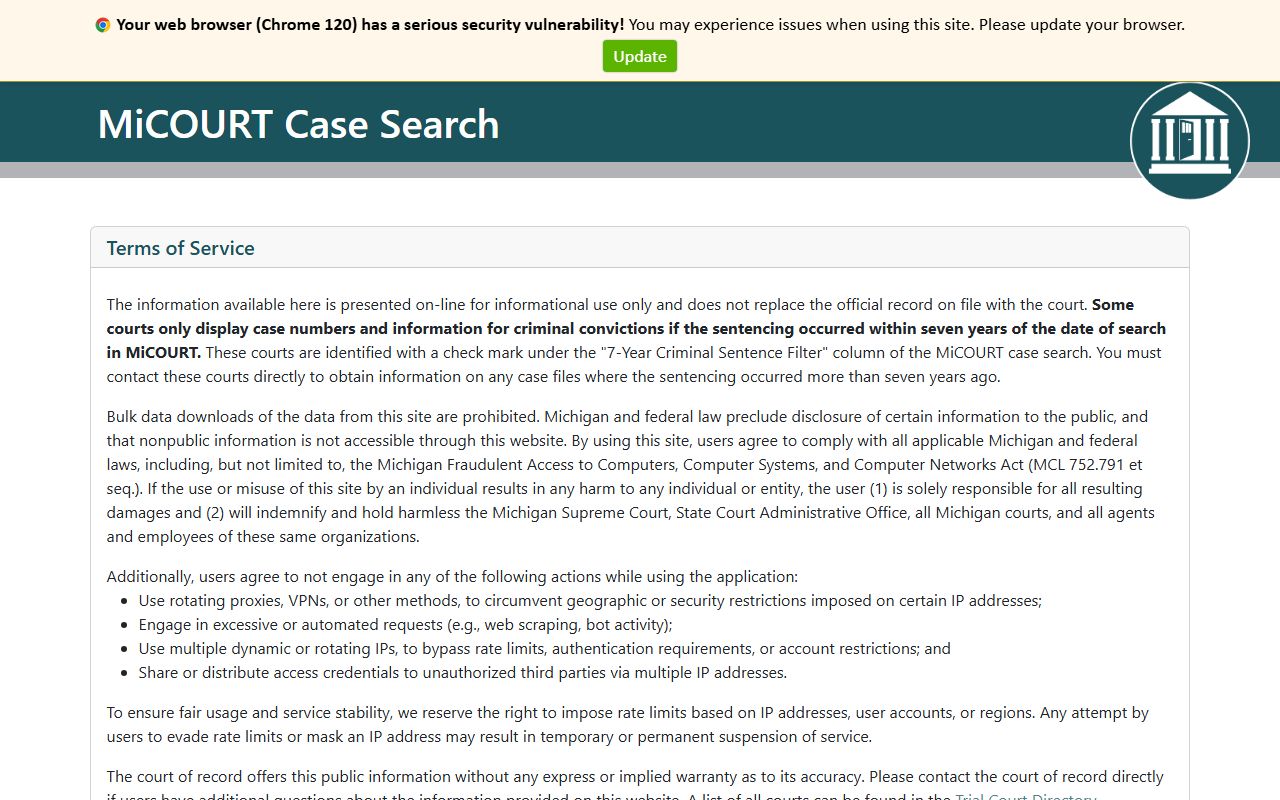
Use the portal for the court record, then confirm unclear entries with the court clerk because portal records can lag behind docket activity.
| MiCOURT Field | How It Helps | Required | Notes |
|---|---|---|---|
| Court | Narrows the search to a district or circuit court | No | Use Tuscola courts when the county is known. |
| Case Number | Finds a known criminal case directly | No | Best when a court notice or docket number is available. |
| Party Name | Searches by defendant name | No | Check spelling, middle initials, and name changes. |
| Date Filters | Limits broad searches by filing or event date | No | Useful when the arrest date is known. |
| Case Type | Filters criminal, traffic, civil, or other case groups | No | Select criminal options when searching charges. |
| Search or Submit | Runs the query | Yes | Review all close matches before ruling out a case. |
Tuscola County Arrest to Court Record
The path is usually arrest, booking, prosecutor review, filing, first appearance, and then later hearings. A booking allegation can be based on the arresting officer's report. The prosecutor then decides which charges, if any, should be filed in court. That distinction matters. A jail entry may say one thing on the day of arrest, while the court record may later show a different charge, a reduced charge, or no filed charge at all.
- Confirm whether the person was booked or released by using jail, court, or custody-notification channels.
- Search MiCOURT by name and narrow to Tuscola County courts when the case appears.
- Open the case record and compare the charge list with the original arrest or booking information.
- Check the next event, bond terms, and whether the case is in district court or circuit court.
- Call the clerk or court listed on the case when online entries conflict or appear incomplete.
Felony cases often begin in district court because that court handles probable cause conferences and preliminary examinations. If the case is bound over, the felony matter moves to circuit court. Misdemeanor cases generally remain in district court. A court record after a Tuscola County jail arrest should be read with that routing in mind.
Tuscola County Charging Documents
Formal criminal charges enter the court file through a charging document. Tuscola County court records after arrest may show different document names based on case type and stage. A complaint is common at the start of a criminal case. An information is used in many felony matters after the case reaches circuit court. An indictment is less common in routine local filings, but it is a recognized way to charge serious offenses through a grand-jury process.
| Document | Who Uses It | What It Does | Reader Caution |
|---|---|---|---|
| Complaint | Prosecutor, often based on police reports | Starts a criminal case and lists the initial formal charges | It may not match every booking allegation. |
| Information | Prosecutor in many felony matters | Sets out felony charges after bindover or filing in circuit court | Check amendments because felony charges can change. |
| Indictment | Grand jury process | Charges an offense through an indictment rather than a standard complaint path | Not the usual document for every local arrest. |
The prosecutor's local page is useful for contact context. The Tuscola County Prosecuting Attorney page identifies the office that reviews reports and makes charging decisions.
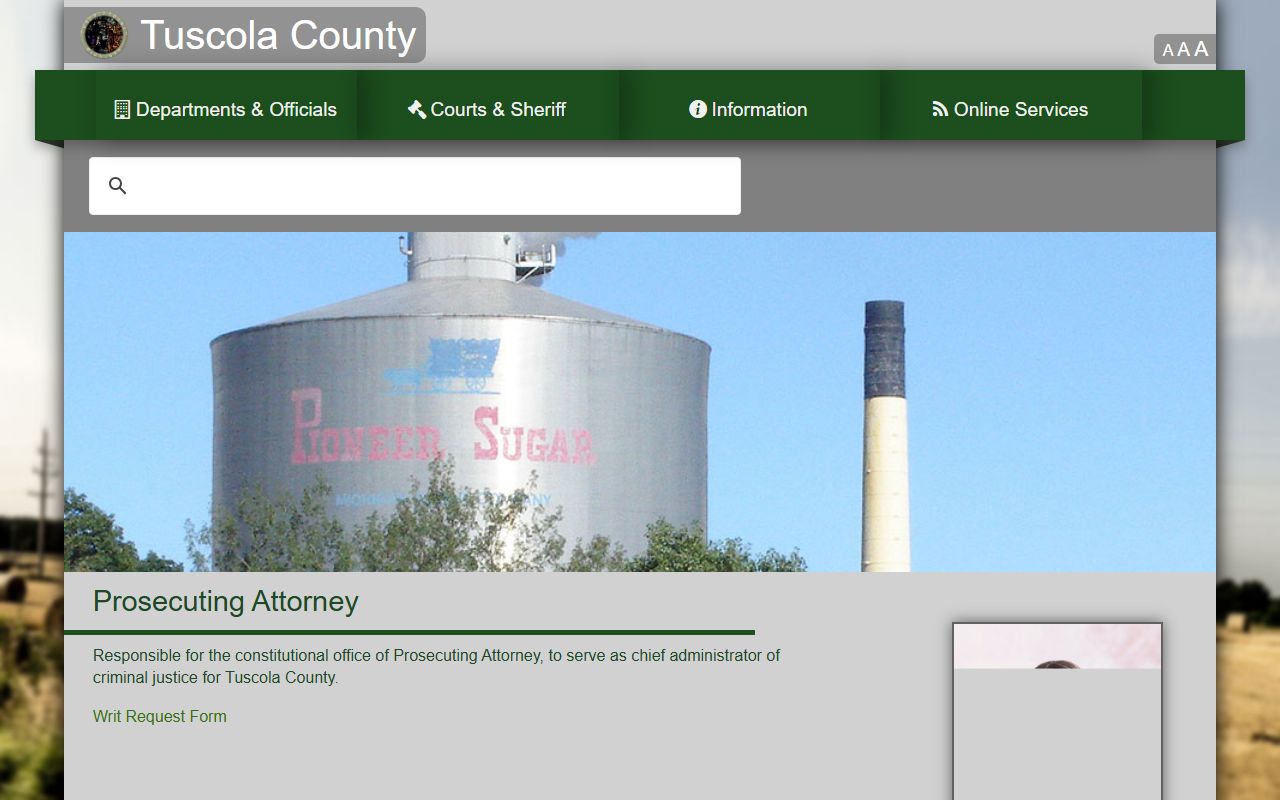
That office is not the court clerk, so filed case records still route through the court and clerk record systems.
Tuscola County Charge Status
Charge status terms explain what has happened to each count in the court file. They should not be treated as the same thing as custody status. A person may be released while charges remain pending, held while a charge is later dismissed, or transferred after sentencing. The case status and the jail status answer different questions.
| Status | Meaning in Court Records | What to Check Next |
|---|---|---|
| Pending | The charge is still active and no final outcome is shown. | Review the next hearing date and bond terms. |
| Amended | The prosecutor or court record shows a changed charge. | Compare the old charge with the current count. |
| Reduced | The charge level or offense was lowered. | Look for a plea, order, or amended document. |
| Dismissed | The count was dropped by order or motion. | Check whether other counts remain open. |
| Disposed | The court has entered a final event on that count or case. | Read the disposition, sentence, or order. |
Note: A booking charge is an allegation at intake, not a final finding by a court.
Tuscola County Bond After Arrest
No Tuscola-specific online bond posting page was found in the research. Bond questions should be confirmed with the jail or the court that has the case. Bond is usually addressed at an early court appearance, but the jail may have practical release information once a judge has set terms. A no-bond hold, detainer, probation hold, or other agency hold can keep a person in custody even when one charge appears bondable.
| Bond Type | How It Works | Common Caution |
|---|---|---|
| Personal recognizance or personal bond | Release based on a promise to appear and obey conditions. | A missed hearing can trigger a warrant. |
| Cash bond | A set cash amount must be posted with the proper office. | Confirm exact amount and payment method first. |
| 10-percent bond | A percentage of the stated bond may be accepted if ordered. | Do not assume it applies unless the court says so. |
| Surety bond | A licensed bonding company may post bond under court rules. | Fees and agreements are private arrangements. |
| No-bond or hold | Release is blocked by court order or another authority. | Ask which court or agency placed the hold. |
Tuscola County Warrants and Court Records
No official Tuscola County active warrant search was found in the research. That means a public warrant check should use several cautious channels instead of one claimed master list. MiCOURT may show warrant-related case activity if a case has already been filed. The sheriff's office, dispatch, the court, and a proper FOIA request may also be relevant, but some warrant information can be restricted for safety or active-investigation reasons.
A warrant can lead to a jail arrest, and the court record after that arrest may show the warrant case, new charges, bond action, or a bench-warrant return. For immediate safety or surrender questions, call the appropriate agency or speak with counsel. Do not rely on an unofficial directory to decide whether a warrant is active.
Tuscola Charges vs Convictions
A charge is an accusation filed in court. A conviction is the result of a guilty plea, no-contest plea accepted by the court, or a guilty verdict. Tuscola County court records after arrest may show charges long before any conviction exists. This is one of the most important limits of any case search.
| Point of Comparison | Charge | Conviction |
|---|---|---|
| Legal meaning | An accusation filed by the prosecutor | A final finding or plea accepted by the court |
| Case stage | Early or active case stage | Disposition or sentencing stage |
| Proof level | Based on probable cause and charging review | Based on proof beyond a reasonable doubt or a plea |
| Public reading | Should not be called guilt | May support a criminal-history entry |
Sealed and Set-Aside Records
Michigan uses set-aside and nonpublic-record concepts that readers often call expungement or sealing. A sealed record is hidden from general public view under a court rule or statute, while a set-aside conviction is handled under Michigan's set-aside process. The practical result can differ by agency, purpose, and record type. Some law-enforcement or court users may retain access even when the public cannot see the record.
| Point of Comparison | Sealed or Nonpublic | Set Aside or Expunged |
|---|---|---|
| Main effect | Limits public access to the record | Changes public treatment of an eligible conviction |
| Where it appears | May disappear from public case search | May not appear in public criminal-history results |
| Who may still see it | Courts or law enforcement in allowed cases | Authorized agencies in limited settings |
| How to confirm | Ask the court clerk about the specific case | Use court orders and state record procedures |
ICHAT Is Not a Jail Roster
Michigan State Police ICHAT is a statewide criminal-history search. It is not a Tuscola County jail roster and it is not a court docket. ICHAT may be useful when the question is whether a public Michigan criminal-history entry exists, but it does not show every court filing, jail booking, suppressed record, or active warrant. Warrants and suppressed records are not available through ICHAT.
For court records after a Tuscola County arrest, use MiCOURT and the local court contacts first. For sentenced state-prison custody, use the MDOC OTIS locator. For victim or custody-status notices, use Michigan VINELink. Each system answers a different question, so a complete search may need more than one channel.
Important: Public lookup information is not a consumer report and may not be used for FCRA-covered decisions.
Restricted Tuscola County Court Records
Some court records after an arrest may not appear in a public search. Juvenile matters, sealed files, nonpublic set-aside records, suppressed entries, and certain active-investigation materials can be withheld from public display. A missing online result does not prove that no arrest, filing, or warrant exists. It may mean the case is too new, filed under a different name, routed to another court, or restricted from public access.
When the public portal and the booking record do not line up, contact the court named on the case or the Tuscola County Clerk for circuit court record questions. For district-stage criminal cases, use the district court contact path. For jail custody, call the Tuscola County Jail or Sheriff's Office at 989-673-8161. Keep names, birth dates, arrest dates, and case numbers ready when asking an official office to check a record.